How to Create a Virtual Influencer: Building Digital Personas That Actually Work
Lil Miquela has 2.7 million Instagram followers, brand partnerships with Prada and Calvin Klein, and a Spotify discography. She is also entirely fictional. Created by the Los Angeles startup Brud in 2016, Miquela Sousa exists as a cluster of 3D renders, a carefully maintained backstory, and an editorial strategy that blurs the line between marketing and performance art. She is not the first virtual influencer, but she is the proof of concept that launched an industry.
That industry is now worth billions. Virtual influencers appear in campaigns for luxury fashion houses, fast food chains, government tourism boards, and tech companies. Some have crossed over into music, fashion design, and media commentary. The question has shifted from "will this work?" to "how do I build one?"
If you are wondering how to create a virtual influencer from scratch, the answer is both more accessible and more complex than the polished Instagram grids suggest.
What Virtual Influencers Actually Are
A virtual influencer is a digitally created character that maintains a social media presence as though it were a real person. The character has a name, a visual identity, a personality, opinions, and a posting schedule. Some are photorealistic. Others are deliberately stylized — anime-inspired, cartoonish, or somewhere in the uncanny valley. The degree of realism is a design choice, not a requirement.
What distinguishes a virtual influencer from a mascot or a cartoon spokesperson is the sustained illusion of personhood. Ronald McDonald is a mascot. Lu do Magalu, the virtual influencer created by Brazilian retailer Magazine Luiza, is a character who posts daily, comments on current events, collaborates with real influencers, and has developed an audience relationship that feels, to followers, indistinguishable from any human creator's presence.
Understanding this distinction matters because it determines your entire creative approach. If you want to create a virtual influencer rather than a branded character, every design decision must serve the illusion of a person with an inner life.
The Technical Stack
The tools needed to create a virtual influencer range from modest to industrial. At the entry level, a team of one or two people with competence in 3D modeling and social media management can produce a functional character. At the high end, studios like Brud and Aww Inc. employ teams spanning 3D artists, writers, social media strategists, motion capture technicians, and voice actors.
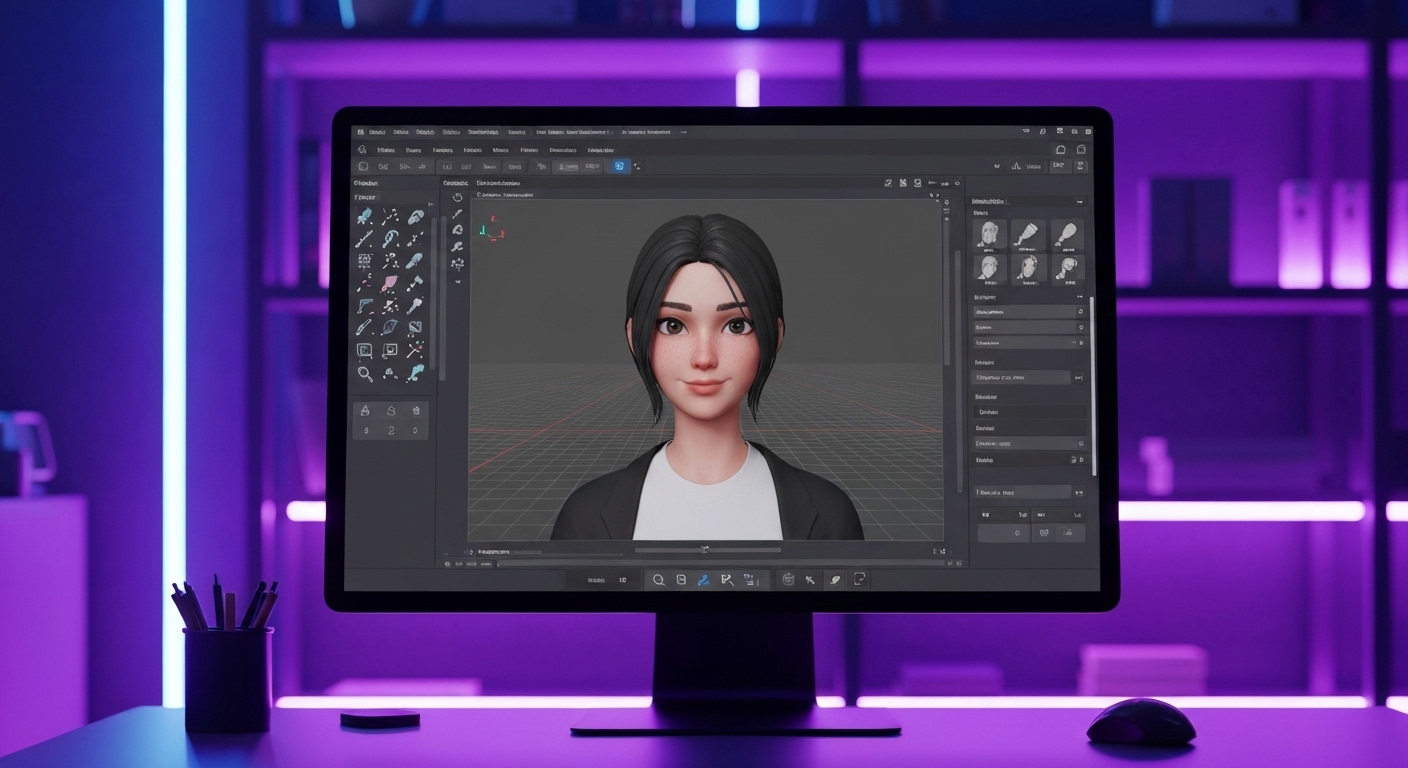
The visual pipeline typically starts with character design in software like Blender, Maya, or ZBrush. The character model needs enough detail and flexibility to be rendered in varied poses, outfits, and environments. For photorealistic results, rendering engines like Unreal Engine's MetaHuman framework or custom pipelines built on Arnold or V-Ray produce the kind of images that pass casual scrutiny on Instagram.
Recent advances in AI image generation have dramatically lowered the barrier. Tools like Stable Diffusion and Midjourney, combined with techniques like LoRA training on a consistent character, allow creators to produce visual content without traditional 3D modeling skills. The trade-off is consistency — maintaining a character's exact appearance across hundreds of generated images requires careful prompt engineering and post-production work. But for those exploring how to create a virtual influencer without a six-figure production budget, AI generation is a legitimate path.
Voice is the next frontier. Text-to-speech engines from ElevenLabs and others can produce natural-sounding voiceovers for TikTok and YouTube content, giving virtual influencers an audible presence that static images cannot achieve. Some creators go further, using AI voice cloning to create a consistent vocal identity that can narrate stories, read comments, or even conduct live streams.
Building a Believable Persona
The technical execution is the easier part. The harder challenge for anyone attempting to create a virtual influencer is developing a persona that audiences actually want to follow. Visual quality alone does not build an audience. Personality does.
Start with backstory. Not the kind of exhaustive lore document you might write for a novel character, but a concise identity framework. Who is this person? What are their interests? What is their perspective on the world? What kind of content do they create, and why would someone follow them instead of the thousands of real people posting about the same topics?
The most successful virtual influencers have clearly defined niches and points of view. Imma, created by Aww Inc. in Japan, focuses on fashion and Japanese street culture with an aesthetic sensibility that is immediately recognizable. Noonoouri, designed by Joerg Zuber, operates in high fashion with a playful, activist-leaning personality. Each has a lane, and each commits to it consistently.
Consistency is the operational word. Learning how to create a virtual influencer is largely learning how to maintain a fictional character's voice, aesthetic, and emotional range across months or years of daily content. One off-character post can shatter the illusion that took hundreds of posts to build.
Platform Strategy and Content Approach
Instagram remains the primary platform for virtual influencers, largely because its image-first format suits rendered content. But TikTok and YouTube are increasingly important, and they demand different production approaches.
For TikTok, static renders are insufficient. The platform rewards motion, audio, and personality. Virtual influencers on TikTok need animated content — lip-syncing, dancing, reacting — which requires either motion capture, manual animation, or AI-driven avatar tools. The production overhead is higher, but the algorithmic reach is significantly greater than Instagram's current distribution.
Content strategy should follow the same principles that guide human influencers: a mix of trend participation, original content, audience interaction, and occasional personal vulnerability. The most effective virtual influencers respond to comments, reference current events, and evolve over time. They are characters in an ongoing story, not static advertisements.
The Ethical Questions Nobody Wants to Answer
If you are serious about learning how to create a virtual influencer, you will eventually confront the ethical dimensions that the industry prefers to discuss in vague terms.
Disclosure is the most immediate issue. Should followers always know they are engaging with a fictional character? Some virtual influencers are transparent about their nature. Others operate in deliberate ambiguity. Current regulations in most jurisdictions do not explicitly address virtual influencer disclosure, but the trend toward transparency requirements in influencer marketing suggests that clarity will eventually become mandatory rather than optional.
Labor displacement is another concern. If a virtual influencer can do the same brand partnership work as a human influencer without requiring travel, accommodation, scheduling, or creative disagreements, the economic logic for brands is compelling. Virtual influencers do not age, do not have scandals, and do not renegotiate rates. For human creators already competing in a saturated market, the emergence of virtual competitors is not an abstract threat.
The most uncomfortable question is the deepest one: what does it mean when audiences form emotional connections with entities that do not exist?
Followers of Lil Miquela have expressed genuine concern during her fictional breakups, celebrated her fictional accomplishments, and defended her against critics as though she were a real friend under attack. These responses are real emotions directed at manufactured stimuli, and the implications for our understanding of parasocial relationships are barely beginning to be explored.
Virtual influencers are not going away. The technology is getting cheaper, the audiences are getting larger, and the brand interest is accelerating. Learning how to create a virtual influencer is, in many ways, learning how to build a new kind of media entity — one that sits at the intersection of character design, social media strategy, artificial intelligence, and storytelling. Whether that intersection produces art or deception depends entirely on the creator's intent and their willingness to be honest about what they are building.